Electromagnetic Brake
Compact brake that closes automatically on power loss
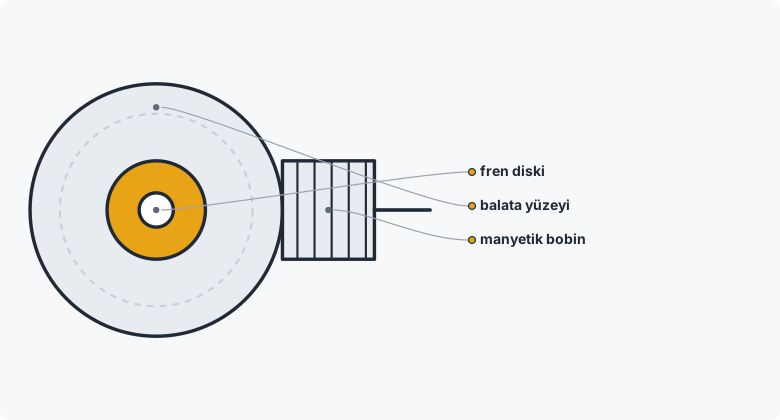
An electromagnetic brake closes automatically by spring force when power is cut. It is compact, motor-integrated or separately mounted, and widely used on crane hoist and travel motors.
An electromagnetic brake opens when its coil is energised and closes by spring force, clamping the lining, when power is cut. This fail-safe principle holds the load even during a power failure.
Use
It is usually integrated into brake motors on hoisting and travel mechanisms. Its compact design makes it common on single girder trolleys, travel drive units and transfer carts. For smooth braking on heavy mechanisms, an electro-hydraulic brake may be preferred.
Maintenance
Air gap adjustment and lining wear should be checked periodically. For brake or lining replacement, submit a service request or request a quote.
Selection and application
The data that drive the selection of a Electromagnetic Brake are the crane’s capacity, duty class (FEM/ISO), travel speed and mounting dimensions. The duty class states how many hours the part must withstand a given load cycle and feeds directly into material, heat treatment and section size. Two cranes of the same capacity in different duty classes do not use the same part.
LIFTKON produces this part both for its own cranes and for other makes already in service. A correct match needs the crane make, capacity, serial number if available and the dimensions of the existing part; a photograph of the worn part also helps. A sketch or drawing can be attached to the quotation form.
Advantages
- Fail-safe principle
- Compact design
- Easy maintenance
Applications
- Hoist and travel motors
- Transfer carts