Single Girder Semi-Gantry Cranes
Single girder crane running on a building runway on one side and a leg on the other
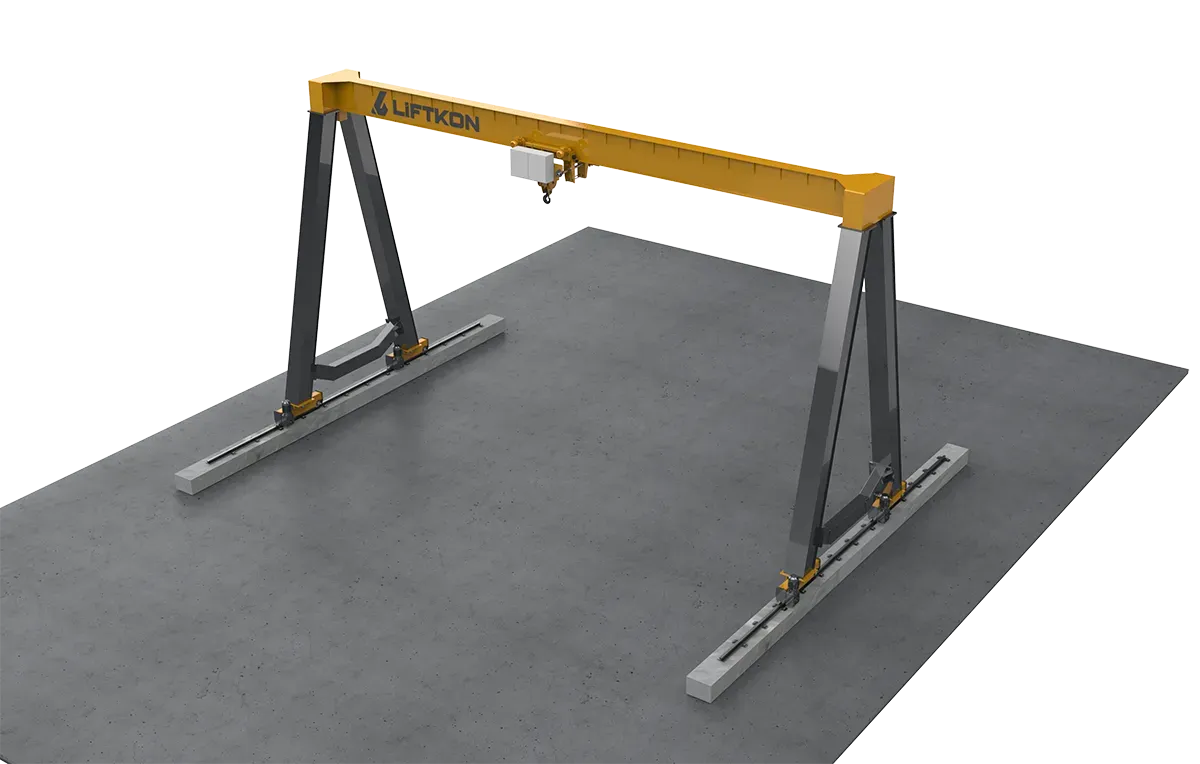
Single girder semi-gantry cranes run on a building runway at one end and on a leg travelling on a ground rail at the other. They are an economical solution where only one side of the building has a runway or where loads move between the building edge and an open area.
A single girder semi-gantry crane combines an overhead crane with a gantry crane. One end of the bridge runs on a runway mounted on the building structure, while the other end is carried by a leg travelling on rails laid on the ground. Only one side of the building needs a runway; the other side needs no columns or runway girder.
When is it used?
A semi-gantry is a practical solution where an existing building allows a runway on one side only, where a second crane must work below an existing overhead crane, or where a line along the bay edge must be served. The single girder design keeps costs low for light and medium loads; lifting is handled by a single girder crane trolley or a monorail hoist trolley.
Design
Leg, girder and travel units are calculated to DIN and FEM principles based on the load, span and rail layout. Travel drives on both sides are controlled together for synchronous movement. The crane is operated by pendant or radio remote control.
Share your site dimensions and load data, and we will decide together whether a semi-gantry, a full gantry crane or a single girder overhead crane fits best and prepare a quote.
Single Girder Semi-Gantry Cranes are built by LIFTKON. Because every unit is engineered for a specific plant, dimensions, duty class and equipment follow the facility’s own data. Share capacity, span, lifting height and daily cycles and the configuration is worked out together with you.
Advantages
- One-sided runway is enoughNo columns or runway girder needed on the other side.
- EconomicalSingle girder design and reduced steelwork.
- Works alongside an existing craneCreates a second lifting axis below an overhead crane.
- Flexible layoutMoves loads between the building edge and open areas.
Applications
- Production baysServing machines along the bay edge.
- Storage areasLoading areas beside the building.
- WorkshopsAuxiliary crane below the main overhead crane.
- Marble and stone processingSlab and block handling.
Industries
Options
- Radio remote control
- Variable speed drives (inverter)
- Chain or wire rope hoist
Safety
- Overload protection
- Hoist and travel limit switches
- Emergency stop
- End stops and buffers
Gallery